The Tax Advantages Awaiting CRE Owners and Investors This Year

It’s that time of year—tax season. As a Commercial Real Estate (CRE) owner or investor, there are federal and state tax benefits you should be discussing with your tax advisor for this year’s filing. On July 4, 2025, Congress enacted the "One Big Beautiful Bill Act" (OBBBA). For the commercial real estate world, this isn't just another bill—it’s a major shift.
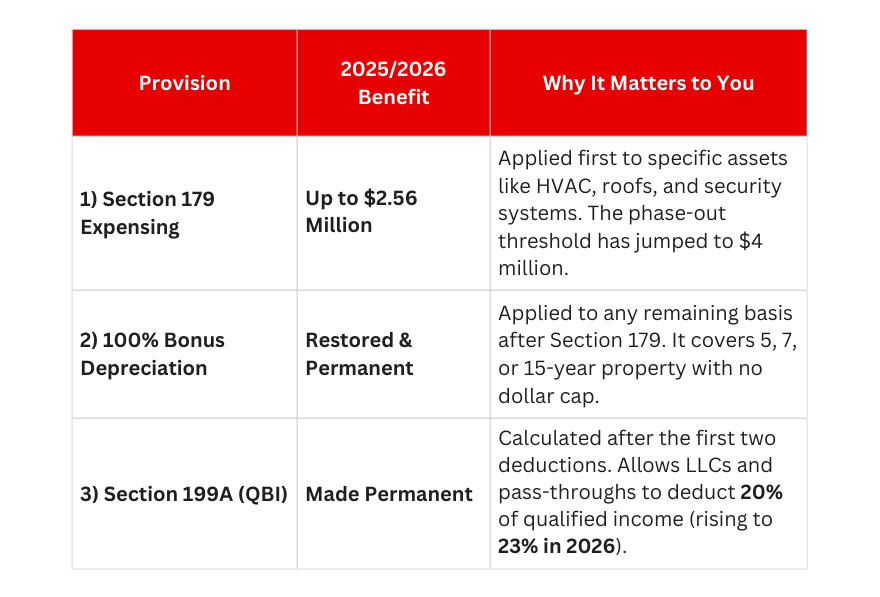
At its core, the OBBBA has permanently restored 100% Bonus Depreciation, allowing you to immediately expense the full cost of qualifying assets in Year 1. This creates a powerful layered system designed to maximize cash flow.
The "Big Three" Federal Benefits
To leverage these new laws, you must understand the "order of operations" for deductions:
What Properties Qualify for 100% Bonus Depreciation?
- 20-Year Recovery Rule: Tangible business property with a MACRS recovery period of 20 years or less—including machinery, equipment, and certain vehicles—is permanently eligible for the 100% deduction if placed in service after January 19, 2025.
- Qualified Improvement Property (QIP): Interior non-structural improvements (lighting, flooring, partitions) qualify, though elevators and building enlargements remain excluded.
- New "Qualified Production Property": A major OBBBA addition allows a 100% deduction for the construction or acquisition of property used primarily for manufacturing, production, or refining.
- Specialized Assets: Eligibility now includes qualified sound recording productions and certain fruit- or nut-bearing plants.
- Excluded Properties: Residential rental structures (27.5-year life), commercial building shells (39-year life), and property acquired from related parties do not qualify.
Here’s an Example of How This Works
When you purchase property or equipment, the deductions are applied in this strict order to reduce your taxable income:
Step 1: Section 179 Expensing
- Applied first to specific assets up to the $2.5 million annual limit.
- Why first? It allows you to be "picky." You can apply it to specific assets (like a new roof or HVAC) while opting out for others to manage your state tax liability.
Step 2: 100% Bonus Depreciation
- Applied to any remaining basis after Section 179 is used.
- The Benefit: Since there is no dollar cap on bonus depreciation, it covers larger investments that exceed the Section 179 limits.
Step 3: QBI Deduction (Section 199A)
- Calculated after the first two deductions have already lowered your business income.
- For 2025, this is a 20% deduction of your remaining qualified income; it increases to 23% in 2026.
The "DMV" Twist: Not All States Play by the Rules
While the federal government has given a green light, local jurisdictions have their own "road signs".
1. Maryland: The "Decoupled" State
Maryland has automatically decoupled from several OBBBA provisions for 2025. While you get the 100% write-off federally, you may have to "add back" that depreciation on your state return.
2. Virginia: A Shift in Conformity
Virginia recently moved to a fixed-date conformity as of December 31, 2025. However, it maintains specific "deconformity" regarding bonus depreciation in many cases.
3. Washington, D.C.: The Legislative Tug-of-War
D.C. is currently a moving target. While the Council initially moved to decouple, federal pressure is pushing the District to remain coupled.
Your Next Step: Review All 2025 Acquisitions
If you have acquired any business property, equipment, or made qualified improvements in 2025, you should immediately review your acquisitions with a tax professional. The potential for immediate, 100% expensing of qualifying assets—made possible by the permanent restoration of Bonus Depreciation—can significantly impact your cash flow this filing year.
A Cost Segregation Study could be a good choice to determine your maximum benefits, especially given the complex state-level conformity issues in the DMV. It's th only way to ensure you're not leaving money on the table is through a detailed analysis of your 2025 purchases.
Note: This analysis is based on the provisions of the "One Big Beautiful Bill Act" (OBBBA), enacted on July 4, 2025. This content is a high-level summary of the tax benefits. Always consult with a qualified tax professional regarding the current tax law and your specific situation.
Sources
- IRS Publication 946: How to Depreciate Property
- IRS Form 4562 Instructions
- Maryland Comptroller Tax Alerts
- Virginia Tax: IRC Conformity
- D.C. Office of Tax and Revenue
Categories
Recent Posts